

FRACTURED GEOPOLITICS

FRACTURED GEOPOLITICS
A contemporary geopolitical theory has emerged that frames the coming decade as the beginning of a prolonged global struggle driven not only by rivalry between states, but by competing civilizational identities, economic systems, religious traditions, technological forces, and internal political fragmentation. At the center of this theory are four primary actors: the United
States, Russia, Iran, and Israel. According to this interpretation, these states are not merely pursuing ordinary national interests. Instead, they are portrayed as carriers of distinct worldviews that increasingly shape the direction of global politics.
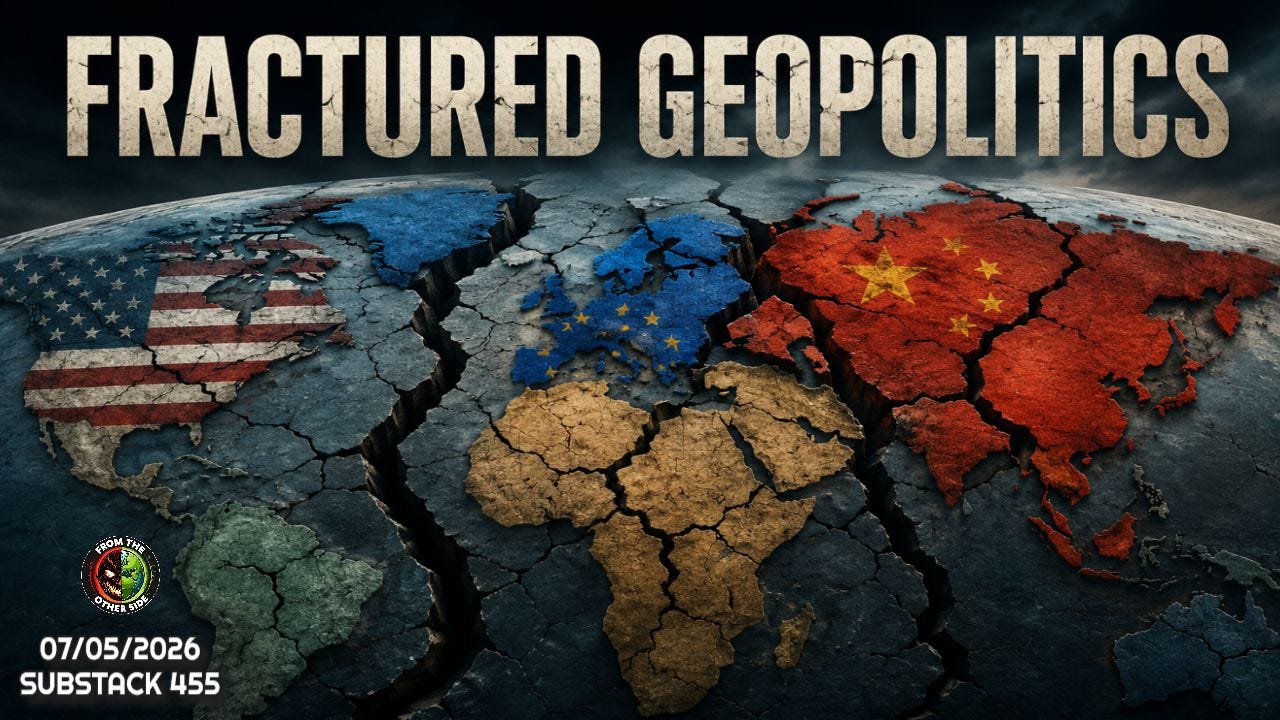
The theory argues that the modern international system is entering a period of systemic breakdown in which proxy wars, ideological conflicts, environmental stress, technological transformation, and elite competition combine into a broader geopolitical confrontation. Rather than viewing current crises as isolated events, this perspective interprets them as interconnected fronts within a larger global transition.
THE FOUR CENTRAL POWERS
Within this framework, the United States and Russia are described as the dominant strategic competitors, while Israel and Iran function as critical regional powers whose confrontation in the Middle East increasingly influences the wider international system.
The conflict between Israel and Iran is interpreted not simply as a regional dispute, but as a proxy struggle between Washington and Moscow. The United States is seen as aligned with Israel, while Russia is viewed as supporting Iran as part of a broader effort to challenge Western influence. According to this interpretation, the Middle East becomes the ignition point for a wider geopolitical escalation capable of spreading far beyond the region itself.
Yet the theory insists that international rivalry alone does not explain the instability. The deeper cause is said to lie inside the states themselves. Internal divisions, elite competition, ideological polarization, and social fragmentation are presented as the true engines driving external conflict.
THE CRISIS OF TRANSNATIONAL CAPITAL
At the heart of this worldview is the belief that the dominant force in global politics over recent decades has been transnational capital — an interconnected network of financial elites, multinational corporations, banking systems, and global economic institutions operating beyond national boundaries.
This system allegedly created a period of relative global prosperity by incentivizing cooperation among wealthy elites across countries. A wealthy Russian, American, Israeli, or Iranian businessman, for example, would often find greater common interest with international financial networks than with ordinary citizens in their own societies.
However, critics of this system argue that globalized capital eventually generated resentment among competing social and political forces. As wealth and influence concentrated further into elite institutions, nationalist movements, religious revivalism, and technological power centers increasingly positioned themselves against global finance.
Three major forces are described as opposing transnational capital:
Nationalism
Religious traditionalism
Artificial intelligence and technocratic systems
Nationalists argue that globalism weakens national sovereignty and cultural identity. Religious movements reject what they perceive as the secular and materialist nature of modern capitalism. Technological forces, particularly artificial intelligence, are viewed as potentially replacing money itself as the organizing principle of society.
According to this theory, these three forces are gradually forming a coalition against the existing global order.
THE INTERNAL CIVIL WAR OF MODERNITY
The theory portrays the modern world as experiencing a hidden civil war between financial globalization and emerging systems of national, religious, and technological authority.
In the United States, this conflict is interpreted through political polarization. Populist nationalism, religious conservatism, and Silicon Valley-driven technological ambitions are seen as converging around new political movements that challenge traditional financial institutions centered around Wall Street and the global banking system.
Artificial intelligence occupies a particularly important place within this framework. Rather than being viewed merely as a technological tool, AI is described as a potential replacement for liberal democratic governance itself. In this interpretation, advanced surveillance systems, algorithmic management, and technocratic governance models could eventually supersede traditional democratic structures.
This vision draws heavily on the concept of the “technate” — a technocratic system governed not by elected politicians but by experts, engineers, algorithms, and AI-driven administration.
ENVIRONMENTAL COLLAPSE AND RESOURCE CONFLICT
Another major component of the theory is environmental destabilization. Ecological pressures are described as a force multiplier that intensifies geopolitical rivalry.
The argument holds that decades of relative climatic stability may be ending, leading to worsening weather patterns, food shortages, energy instability, and increased competition for scarce resources. Under these conditions, nations are expected to become increasingly aggressive in securing agricultural production, supply chains, strategic minerals, and energy routes.
Famine, mass migration, and ecological disasters are predicted to become central drivers of geopolitical instability in the coming decade.
In this interpretation, environmental collapse does not replace geopolitical conflict — it accelerates it.
WHY OTHER POWERS ARE CONSIDERED SECONDARY
Despite acknowledging the economic weight of countries such as China, India, Germany, Japan, Brazil, and South Africa, the theory argues that these states lack what it calls a “grand strategy” capable of mobilizing society for total conflict.
China, in particular, is described as historically isolationist. The concept of the “Middle Kingdom” is used to argue that Chinese civilization traditionally viewed itself as self-contained rather than expansionist in the Western imperial sense. Contemporary globalization is therefore interpreted as temporary rather than permanent.
India is similarly portrayed as a civilization more focused on internal continuity than external domination.
The argument is not that these states lack power, but that they allegedly lack the ideological and civilizational cohesion required for prolonged global confrontation.
THE THREE CURRENT BATTLEFIELDS
Three major active fronts are identified within this geopolitical framework.
Ukraine
Ukraine is presented as a proxy war between NATO and Russia, with the United States acting through European institutions and military alliances.
The Middle East
Iran and Israel represent the second major battlefield. The conflict is interpreted as part of a broader struggle over regional dominance, religious legitimacy, and geopolitical restructuring.
Cuba and the Western Hemisphere
Less commonly discussed within mainstream geopolitical analysis, Cuba is framed as another strategic front. The continued American embargo and Russian support for Havana are interpreted as part of the broader US–Russia confrontation.
These fronts are expected to multiply as tensions increase.
THE RETURN OF GREAT POWER ARMAMENT
The theory predicts the rearmament of secondary powers such as Germany and Japan.
Germany is viewed as the historical center of European power, while Japan is considered the traditional strategic center of East Asia. Since the United States requires allies to contain both Russia and China, the argument suggests that Washington will increasingly encourage military expansion among these nations.
Other regional powers — including Poland, Turkey, and North Korea — are expected to exploit global instability to increase their own influence.
The result, according to this vision, is an increasingly fragmented and militarized international system.
THE CHESSBOARD OF GRAND STRATEGY
The theory uses chess as a metaphor for understanding geopolitical behavior.
The king represents the political system.
The queen represents grand strategy.
The bishops, knights, and rooks represent attack vectors and strategic tools.
The pawns represent expendable assets and proxies.
Victory in modern conflict is therefore defined not primarily by military conquest, but by destabilizing the opponent’s political system.
THE UNITED STATES: TECHNOCRATIC IMPERIALISM
The United States is described as a democracy whose greatest strength is innovation and openness, but whose greatest vulnerability is polarization.
The theory argues that America cannot realistically be defeated through direct military confrontation. Instead, its primary weakness lies in internal division. Political polarization, social fragmentation, and ideological extremism are viewed as the most effective means of weakening American power.
The American grand strategy is described as “Greater North America” — the idea that the continent itself constitutes a self-sufficient fortress protected by geography, resources, and economic dominance.
Technology plays a central role in this vision. AI surveillance systems, digital infrastructure, precision weapons, global media networks, and the dominance of the US dollar are presented as the pillars of American power.
Within this framework, the United States seeks not global stability, but managed instability — creating conditions in which the rest of the world becomes dependent on American finance, weapons, technology, and resources.
ANGLO-AMERICAN CIVILIZATION AND THE IDEAL OF INDIVIDUALISM
The theory places enormous emphasis on culture and literature as expressions of geopolitical identity.
Works such as Paradise Lost, Hamlet, Faust, and The Fountainhead are interpreted as representing the Anglo-American celebration of individual ambition, rebellion, achievement, and self-transformation.
The story of Adam and Eve is reframed not as a warning against rebellion, but as a justification for intellectual ambition and the pursuit of godlike power through knowledge.
Within this worldview, progress emerges through disobedience, innovation, and the refusal to accept imposed limitations.
RUSSIA: THE THIRD ROME
Russia is described as fundamentally different from the Anglo-American tradition.
Its political system is portrayed as autocratic, allowing for long-term strategic planning but creating vulnerability through overdependence on central leadership.
The Russian grand strategy is identified as the “Third Rome” doctrine — the belief that Moscow inherited the spiritual and civilizational role of Rome and Constantinople.
Russia is presented as a defender of religious civilization against secular liberalism. Orthodoxy, Eurasian geography, and military endurance become the pillars of Russian strategy.
Unlike the Anglo-American focus on individual achievement, Russian civilization is framed around duty, humility, sacrifice, and spiritual redemption.
Works such as Crime and Punishment and Anna Karenina are used to illustrate the dangers of pride, ego, and the pursuit of self-deification.
In this interpretation, the Russian worldview rejects the idea that humanity can become godlike through progress. Instead, fulfillment is found through duty, moral restraint, and submission to transcendent authority.
IRAN: MARTYRDOM AND RELIGIOUS DESTINY
Iran is described as a theocracy whose strength lies in ideological cohesion and religious endurance.
Its grand strategy is presented as “Shia exceptionalism” — the belief that Iran is destined to lead the Muslim world.
The theory emphasizes the historical divide between Sunni and Shia Islam, positioning Iran and Saudi Arabia as competing centers of Islamic authority.
Iran’s strategic advantages are described as:
Religious faith
Geographic terrain
Proxy networks such as Hezbollah and Hamas
Missile and drone warfare
The culture of martyrdom, particularly through the memory of the Battle of Karbala, is presented as central to Iranian strategic thinking. Sacrifice and endurance are considered more important than material power.
ISRAEL: APOCALYPTIC STRATEGY
Israel is portrayed as combining democratic structures with religious identity.
Its grand strategy is described as the “Greater Israel Project,” rooted in biblical interpretations regarding territory stretching from the Nile to the Euphrates.
Israel’s strategic tools are identified as:
Religious legitimacy through biblical narratives
Intelligence operations
Global diaspora networks
The theory places particular emphasis on the role of intelligence and covert operations, arguing that strategic instability in the Middle East ultimately benefits Israeli objectives.
Mystical traditions associated with the Kabbalah are interpreted as shaping a worldview in which conflict, crisis, and historical upheaval are not accidents but necessary stages in a larger process of redemption.
CIVILIZATIONAL CONFLICT
The broader conclusion of this theory is that geopolitics is no longer driven solely by economics or military competition. Instead, the world is entering an era of civilizational conflict in which states increasingly act according to deeply rooted cultural, religious, technological, and ideological identities.
The United States represents technological ambition and radical individualism. Russia represents spiritual hierarchy and civilizational duty. Iran represents religious endurance and martyrdom. Israel represents prophetic destiny and historical acceleration.
These competing visions, according to the theory, make compromise increasingly difficult because the conflict is not merely territorial or economic. It is existential and philosophical.
Whether such predictions prove accurate remains uncertain. Yet the framework reflects a growing trend in geopolitical thinking that sees the modern international order not as stable and permanent, but as entering a prolonged period of fragmentation, ideological polarization, technological transformation, and systemic instability that could define global politics for years to come.