

FRACTURED WORLD ORDER

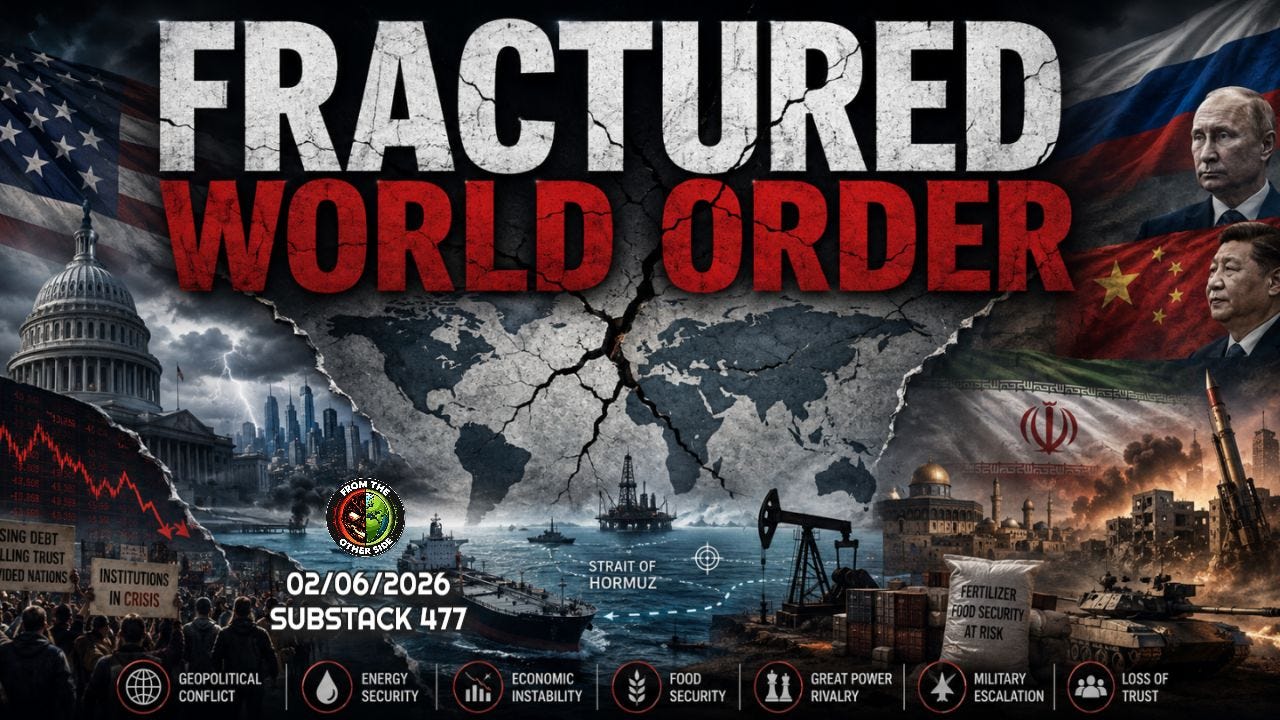
FRACTURED WORLD ORDER
The international system is entering a period of profound instability as multiple geopolitical crises converge against a backdrop of shifting power balances, economic strain, and declining confidence in long-established institutions. Periods of major transition in world affairs have historically been marked by conflict, disruption, and the collapse of existing assumptions. From the aftermath of the Second World War to the dissolution of the Soviet Union, moments when power is redistributed across the international system have rarely occurred peacefully.
Today, many observers argue that the world may once again be approaching such a turning point. The conflict involving Iran, the growing tensions between major powers, the war in Ukraine, and mounting economic pressures throughout the Western world are increasingly viewed not as isolated events but as interconnected components of a larger transformation.
The Strategic Importance of the Middle East
Few regions are more critical to the global economy than the Persian Gulf. For decades, the Gulf states have occupied a central position in the international energy system. Oil and natural gas exports from the region have powered industrial economies across Europe, Asia, and North America while simultaneously underpinning the global financial system through the recycling of petrodollars into Western markets.
Any prolonged disruption to the flow of energy through the Strait of Hormuz would have consequences far beyond the Middle East. A significant portion of global oil shipments passes through the narrow waterway, making it one of the most strategically important maritime chokepoints on Earth.
The implications extend beyond energy. Modern agriculture depends heavily on fertilizers and global supply chains that are themselves dependent upon stable energy supplies and uninterrupted maritime transport. Severe disruptions could therefore affect food production, transportation, manufacturing, and economic growth across multiple continents.
Many analysts warn that the world remains poorly prepared for a sustained interruption of these systems. Strategic reserves may soften short-term shocks, but prolonged instability would create cascading effects that could reach far beyond the battlefield.
Iran and the Regional Balance of Power
The conflict surrounding Iran has become a focal point for broader debates about the future balance of power in the Middle East.
Iran occupies a unique geopolitical position. It sits astride key energy routes while maintaining relationships with regional actors stretching from the Persian Gulf to the Eastern Mediterranean. Any strengthening of Iran’s regional influence would inevitably reshape the calculations of neighboring states.
For Gulf monarchies such as Saudi Arabia and the United Arab Emirates, the prospect of a more influential Iran raises significant security concerns. These states have spent decades building economic models based on stability, investment, trade, and integration into global markets. Regional conflict threatens these foundations.
The UAE, in particular, has invested heavily in positioning Dubai as a global hub for finance, logistics, and international commerce. Persistent instability in the Gulf undermines that role and damages investor confidence.
At the same time, Israel continues to view regional security through the lens of long-term strategic competition. Ongoing tensions in Lebanon, Syria, Gaza, and elsewhere create a complex web of conflicts that remain unresolved despite repeated diplomatic efforts.
As a result, the Middle East increasingly resembles a system in which multiple actors possess incompatible objectives. This makes durable peace difficult to achieve even when temporary ceasefires emerge.
The Limits of Negotiated Settlements
Diplomatic negotiations often focus on specific issues such as sanctions, nuclear programs, territorial disputes, or military withdrawals. Yet the deeper challenge lies in the fact that these issues are interconnected.
Any agreement involving Iran would need to address not only questions surrounding nuclear activities but also broader security concerns involving regional allies, military deployments, and the future balance of power.
History suggests that agreements reached without resolving underlying strategic rivalries often serve only as temporary pauses rather than permanent solutions. This dynamic has characterized many conflicts throughout the modern Middle East.
Even when negotiations produce short-term reductions in violence, competing regional ambitions frequently re-emerge, creating new crises that undermine previous settlements.
Russia, China, and Diverging Strategic Approaches
The responses of Russia and China illustrate how major powers increasingly view global conflicts through different strategic lenses.
Russia tends to interpret many international crises through the framework of security competition and strategic confrontation. From Moscow’s perspective, events in regions such as Ukraine and the Middle East are often connected to broader struggles over influence, sovereignty, and the future structure of the international order.
China’s approach has generally emphasized economic stability, trade continuity, and conflict management. Beijing’s rapid rise has been built upon decades of relative international stability and access to global markets. Consequently, Chinese policymakers frequently place greater emphasis on mediation, de-escalation, and preserving economic relationships.
These differing approaches do not necessarily imply disagreement on every issue. Rather, they reflect distinct historical experiences and strategic priorities.
Russia often sees instability as an unavoidable feature of international politics, while China has generally benefited from postponing confrontation and maximizing economic development.
This distinction helps explain why the two powers may respond differently to crises despite sharing certain broader geopolitical interests.
Ukraine and the Persistence of War
The war in Ukraine remains one of the defining geopolitical conflicts of the twenty-first century.
As the conflict continues, sharply contrasting narratives have emerged regarding its trajectory and likely outcome. Supporters of continued military assistance argue that sustained backing can alter the balance on the battlefield. Critics contend that expectations of decisive victory have repeatedly failed to materialize.
Regardless of perspective, the war has exposed significant divisions within Western societies and institutions. It has also intensified debates about military spending, industrial capacity, alliance commitments, and strategic priorities.
The conflict has demonstrated the enormous resource demands of modern warfare. Massive consumption of ammunition, missiles, drones, and military equipment has highlighted vulnerabilities in defense production systems across multiple countries.
At the same time, the war has reinforced broader questions regarding escalation, deterrence, and the risks associated with prolonged great-power confrontation.
America’s Strategic Dilemma
Underlying many contemporary geopolitical debates is the question of American power.
The United States remains the world’s most influential military, financial, and technological power. Yet it also faces growing fiscal pressures. Rising debt levels, increasing interest payments, industrial competition, and domestic political polarization have generated concerns about the sustainability of the post-Cold War order.
Some analysts argue that Washington is attempting to adapt to a world in which it can no longer maintain the same level of global dominance it once enjoyed. Others contend that American power remains unmatched and that predictions of decline are premature.
What is increasingly clear, however, is that allies and adversaries alike are reassessing long-held assumptions regarding American capabilities and commitments.
Questions that once seemed settled are now being openly debated:
Can the United States continue to underwrite global security at previous levels?
How should allies respond if American priorities shift?
What happens when economic constraints collide with geopolitical ambitions?
These questions are shaping strategic calculations from Europe to East Asia.
Asia and the Future of Great-Power Competition
The Asia-Pacific region is emerging as the central arena of long-term strategic competition.
China’s rise has transformed the regional balance of power and challenged assumptions that dominated the post-Cold War era. Questions surrounding Taiwan, maritime security, technological competition, and military modernization continue to shape regional politics.
At the same time, countries such as Japan and South Korea face increasingly difficult choices. Their economies remain deeply connected to regional trade networks while their security structures remain closely tied to the United States.
This creates a strategic dilemma that has become increasingly pronounced as competition between Washington and Beijing intensifies.
The future of Taiwan remains particularly significant. Any change to the status quo would have implications not only for regional security but also for global technology supply chains, especially given Taiwan’s central role in advanced semiconductor manufacturing.
While predictions about specific outcomes remain highly uncertain, few analysts dispute that East Asia will remain one of the most important geopolitical theatres of the coming decades.
The Crisis of Western Institutions
Beyond military and geopolitical questions lies another issue that increasingly dominates political discourse: institutional legitimacy.
Trust in governments, political parties, media organizations, and public institutions has declined across much of the Western world. Polling data in numerous countries shows falling confidence in traditional authorities and growing dissatisfaction with political systems.
Several factors contribute to this trend.
Demographic challenges have intensified economic pressures. Aging populations, declining birth rates, rising housing costs, and concerns over immigration have generated social tensions throughout many developed societies.
Economic financialization has also become a source of criticism. Many observers argue that modern economies increasingly reward speculation, asset ownership, and financial engineering at the expense of productive investment and long-term development.
Wealth concentration has become another flashpoint. The growing gap between wealthy elites and ordinary citizens has fueled perceptions that economic systems are becoming less responsive to the broader public.
Simultaneously, debates surrounding censorship, freedom of expression, media credibility, and political conformity have further eroded trust in institutions.
The cumulative result is a widespread sense that traditional systems are struggling to maintain legitimacy in the face of accelerating change.
Historical Cycles and Civilizational Anxiety
Throughout history, periods of decline have often been associated with recurring patterns: demographic stagnation, economic concentration, institutional decay, political polarization, and loss of social cohesion.
Thinkers ranging from ancient historians to modern scholars such as Oswald Spengler have argued that civilizations experience cycles of growth, maturity, and decline.
Whether contemporary Western societies are genuinely entering such a phase remains a matter of intense debate. However, the perception that decline is underway has become increasingly influential in political discourse.
This perception shapes everything from electoral politics to foreign policy decisions and public attitudes toward globalization, immigration, economic policy, and national identity.
Conclusion
The world appears to be entering a period defined by uncertainty, fragmentation, and strategic competition. The conflict involving Iran, the ongoing war in Ukraine, tensions in East Asia, and the erosion of institutional trust across much of the West are increasingly viewed as symptoms of a broader transformation in the international system.
Periods of geopolitical transition rarely unfold smoothly. Established powers seek to preserve influence, rising powers seek greater roles, and regional actors pursue their own interests amid shifting circumstances. Economic pressures, military rivalries, and domestic political challenges further complicate the picture.
Whether the coming years produce a stable multipolar order or a prolonged era of confrontation remains uncertain. What is clear is that assumptions that guided international politics for decades are being challenged simultaneously across multiple fronts.
The significance of this moment lies not in any single conflict but in the convergence of many. As economic, political, and military pressures interact, the world may be witnessing not merely another geopolitical crisis, but the emergence of an entirely new international era.