

REALITY AGAINST IDEOLOGY

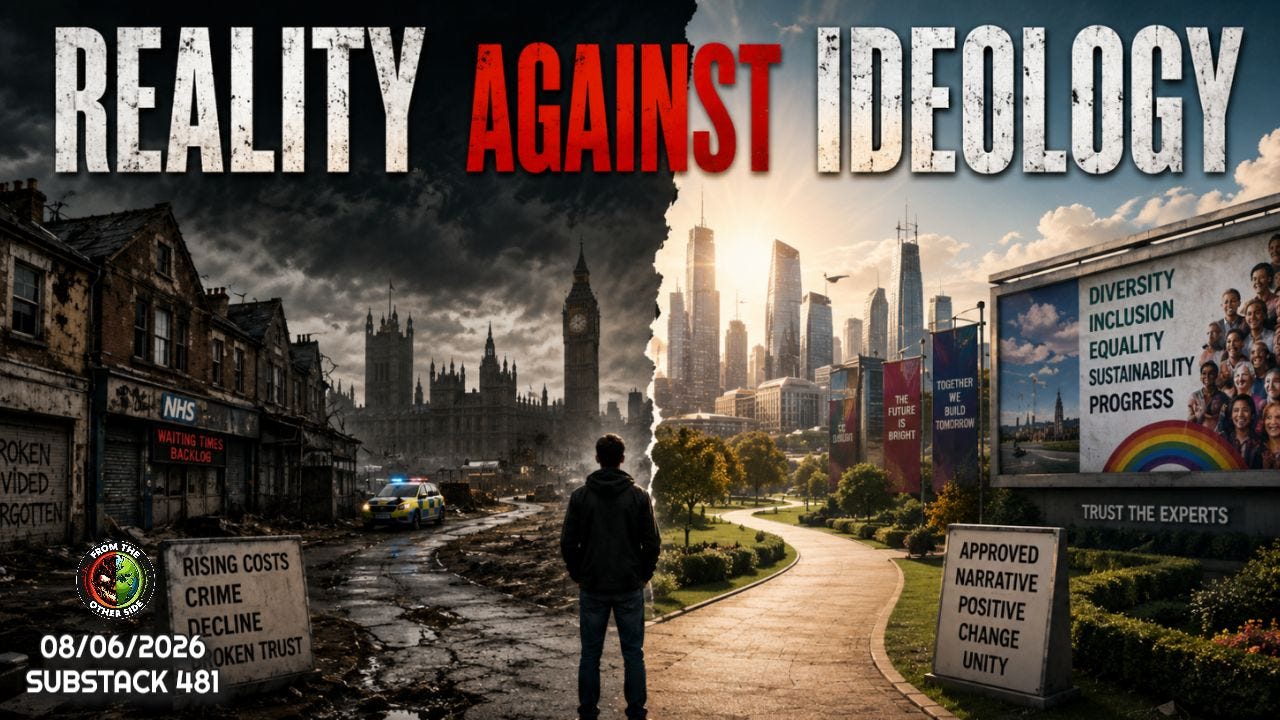
REALITY AGAINST IDEOLOGY
Across much of the Western world, a growing number of citizens increasingly feel that they are living through a period of profound national, cultural, and institutional decline. What was once dismissed as fringe pessimism has gradually entered mainstream political discourse. Concerns about economic stagnation, failing public services, demographic change, cultural fragmentation, and declining trust in institutions are no longer confined to political outsiders. They have become recurring themes in public debate.
At the heart of this growing dissatisfaction lies a simple argument: reality itself is becoming politically disruptive.
For many people, the daily experience of life appears increasingly disconnected from the optimistic narratives offered by political leaders, media institutions, and cultural elites. The visible deterioration of infrastructure, rising costs of living, housing pressures, declining public trust, growing social tensions, and concerns about national identity have created a widening gap between official messaging and lived experience.
The result is a growing belief among many citizens that merely describing observable realities has become controversial. Issues that were once considered ordinary political concerns are increasingly framed as moral questions or ideological disputes. This perception has fuelled the belief that public discourse has become detached from practical reality and more concerned with enforcing approved narratives.
The Crisis of Institutional Confidence
One of the most significant developments of the early twenty-first century has been the collapse of public confidence in institutions.
Historically, institutions derived legitimacy from performance. Governments maintained authority by providing security, prosperity, stability, and a functioning legal order. Public services gained trust by delivering tangible results. Citizens accepted authority because authority appeared competent.
Today, however, many people increasingly perceive the opposite.
Across Britain and much of the West, concerns have emerged regarding healthcare backlogs, policing failures, declining educational standards, rising crime, deteriorating infrastructure, and bureaucratic inefficiency. Whether these perceptions are entirely accurate is almost secondary to the fact that they are widely held.
The deeper problem is psychological. When institutions lose credibility, citizens begin searching for alternative explanations. Official narratives become less persuasive, and people increasingly rely on personal observation rather than institutional authority.
This process can become self-reinforcing. Every visible failure reinforces broader doubts about competence. Every contradiction between public messaging and lived experience deepens mistrust.
The result is a society increasingly divided between those who continue to trust established institutions and those who believe those institutions have fundamentally failed.
Propaganda and the Invisible Ideology
A central argument advanced by critics of contemporary Western systems is that modern propaganda is effective precisely because it is rarely recognized as propaganda.
Unlike the overt political messaging of twentieth-century authoritarian states, contemporary influence is often embedded within culture itself. Entertainment, education, advertising, corporate messaging, news media, and digital platforms all transmit assumptions about society, identity, economics, morality, and politics.
Because these assumptions are omnipresent, they often appear natural rather than ideological.
This phenomenon was recognized by political theorists long before the internet age. Figures such as Walter Lippmann and Edward Bernays explored how public opinion could be shaped through mass communication. Their work helped establish many of the techniques later adopted by governments, corporations, and media organizations.
Critics argue that modern populations are not less propagandized than previous generations. Instead, the propaganda has become more sophisticated, decentralized, and culturally embedded.
The most effective ideology is often the one people no longer perceive as ideology.
Liberalism and the Promise of Utopia
Many contemporary critics trace current political and cultural tensions back to the dominance of liberal ideology.
For more than a century, liberal democracy has presented itself as the natural endpoint of political development. Individual rights, global integration, expanding freedoms, and economic globalization were portrayed as inevitable steps toward a more prosperous and peaceful future.
Yet growing numbers of observers argue that this vision has encountered serious limitations.
The philosopher John Gray has repeatedly challenged the assumption that history moves toward moral progress. His work questions the belief that humanity inevitably becomes wiser, more rational, or more virtuous over time.
Critics argue that much of modern politics is built upon precisely that assumption.
The belief that society naturally progresses toward a better future creates an expectation that every social change is inherently beneficial. Problems become temporary obstacles rather than evidence of systemic failure. Contradictions are dismissed as transitional difficulties on the road to a promised destination.
The danger, according to this critique, is that political movements become attached to visions of perfection that can never actually be achieved.
History provides numerous examples of societies pursuing utopian goals at immense human cost. The promised destination continually recedes into the distance while the sacrifices required to reach it continue to grow.
The dream remains intact even as reality increasingly contradicts it.
Family, Community, and Social Fragmentation
Another recurring theme in contemporary political criticism is the weakening of traditional social structures.
The family, local community, religious institutions, and national identity once provided meaning, stability, and continuity. Critics argue that many of these institutions have been weakened by economic pressures, cultural change, and ideological transformation.
Particular concern is often expressed regarding the changing nature of family life.
Rising childcare costs, dual-income households, housing pressures, and changing social expectations have transformed the structure of family life across the West. Critics argue that economic systems increasingly reward market participation while undervaluing caregiving, parenting, and community-building.
The result, they contend, is a society where economic activity has become the dominant measure of value while many non-economic forms of human fulfillment have been marginalized.
Whether one agrees with this diagnosis or not, the broader concern reflects a widespread anxiety that economic systems are increasingly shaping social life rather than serving it.
The National Question
Immigration, demographic change, and national identity remain among the most contentious political issues in Western societies.
For some, increasing diversity represents cultural enrichment and economic dynamism.
For others, it raises questions about social cohesion, national continuity, and the preservation of shared traditions.
The intensity of these debates reflects a deeper disagreement about the nature of the nation itself. Is a nation primarily a legal framework, an economic zone, a collection of shared values, or a historical people connected by culture, memory, and tradition?
The answer profoundly influences attitudes toward immigration, integration, citizenship, and national policy.
As these questions become more politically charged, they increasingly define electoral politics throughout Europe and North America.
The Revolt Against Expertise
The growing rejection of traditional authority is not limited to politics.
Experts, academics, journalists, bureaucrats, and professional institutions have all experienced declining levels of public trust. The internet has accelerated this process by allowing alternative viewpoints to reach large audiences without institutional gatekeepers.
Critics view this development as a necessary correction to elite dominance.
Supporters of established institutions often view it as a dangerous erosion of expertise.
In reality, both dynamics may be occurring simultaneously.
The democratization of information has empowered ordinary citizens while also creating new challenges involving misinformation, polarization, and competing interpretations of reality.
The struggle increasingly revolves around a fundamental question: who gets to define reality?
The Search for Restoration
As dissatisfaction with existing systems grows, new political movements have emerged that promise restoration rather than transformation.
Unlike traditional revolutionary movements, these groups often present themselves not as advocates of radical change but as defenders of continuity, stability, and national renewal.
Their appeal rests upon a simple message: before pursuing grand ideological projects, societies must first ensure that basic functions work.
Safe streets, functioning institutions, affordable housing, energy security, industrial capacity, economic opportunity, and national cohesion become priorities over abstract ideological ambitions.
This emphasis on restoration reflects a growing belief that many Western nations face long-term structural challenges requiring strategic planning rather than short-term electoral calculations.
Critics of contemporary politics frequently argue that governments have become trapped in media cycles, public relations campaigns, and electoral incentives that discourage long-term thinking.
The distinction between politicians and statesmen, once widely discussed in political theory, has re-emerged as a significant concern.
An Age of Reckoning
The broader significance of these debates extends beyond any single political movement or ideology.
Across the West, societies are confronting fundamental questions about identity, governance, legitimacy, prosperity, and the future direction of civilization itself.
Many citizens increasingly believe that established systems no longer reflect their interests, values, or lived experiences. Others remain convinced that existing institutions, despite their flaws, remain the best framework for managing complex modern societies.
This divide is unlikely to disappear.
Instead, it appears destined to shape political life for years to come.
Conclusion
The defining political struggle of the present era may not be between left and right, progressive and conservative, or even globalist and nationalist. It may be a conflict between competing understandings of reality itself.
As economic pressures mount, institutions lose credibility, and social cohesion weakens, increasing numbers of people are questioning assumptions that once seemed beyond dispute. Whether these concerns ultimately lead to renewal, reform, or further polarization remains uncertain.
What is clear is that a growing portion of the population believes the gap between official narratives and everyday experience has become impossible to ignore. The challenge facing modern societies is whether that gap can be closed through honest engagement with reality—or whether the divide will continue to widen until trust in the entire system finally breaks.