

SOUTHAMPTON PROTEST TURNS VIOLENT

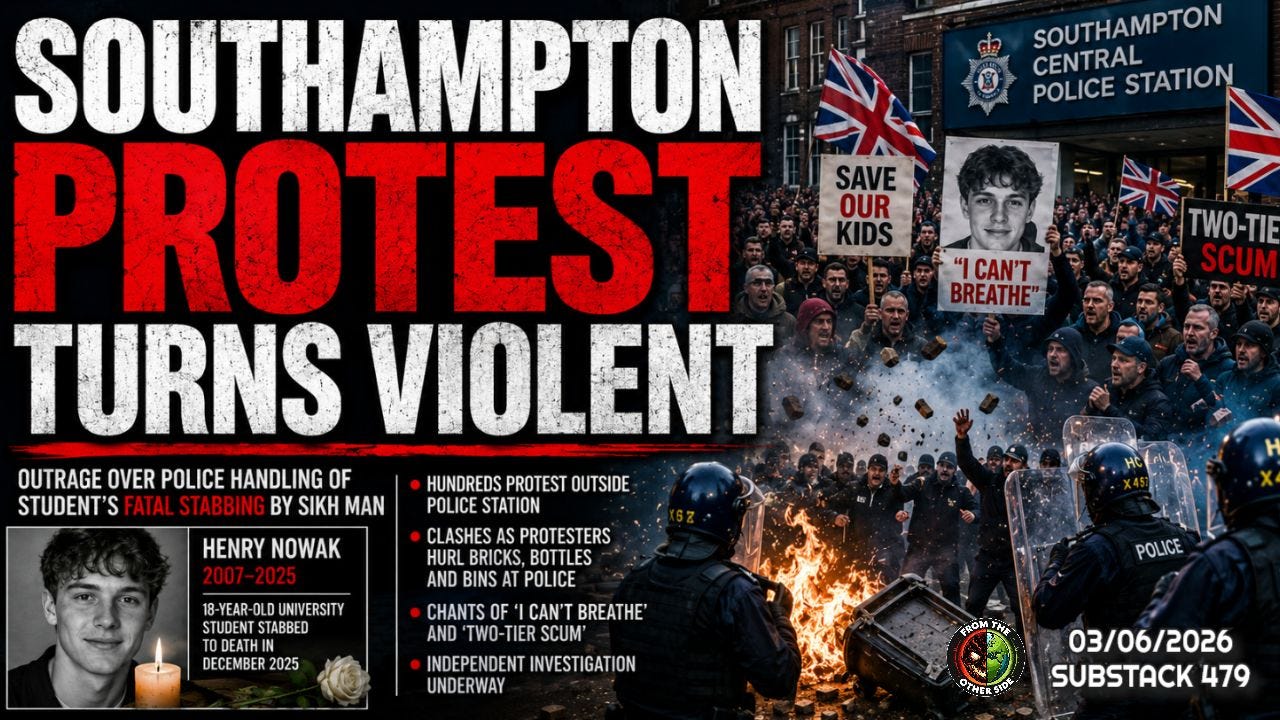
SOUTHAMPTON PROTEST TURNS VIOLENT
Protests Turn Violent in Southampton Over Police Handling of Student’s Fatal Stabbing by Sikh Man.
Hundreds of demonstrators gathered outside Southampton Central Police Station on Tuesday, June 2, 2026, protesting the police response to the December 2025 murder of 18-year-old university student Henry Nowak. The protest, which later escalated into clashes with officers, erupted one day after the killer’s sentencing and the release of bodycam footage showing Nowak—bleeding to death from multiple stab wounds—being handcuffed by officers who appeared to believe the attacker’s false claim of a racist assault.
The case has ignited a national debate over policing priorities, race, and claims of “two-tier” justice in Britain.The Killing in Southampton.
On a December evening in 2025, Nowak, a white British finance student at the University of Southampton, was walking home from a pub when he encountered 23-year-old Vickrum Digwa, a Sikh man. According to court evidence, a verbal exchange escalated when Nowak filmed Digwa and called him a “bad man.” Digwa grabbed the phone and stabbed Nowak five times with a 21cm blade—one of two knives he was carrying, including a larger dagger alongside a smaller kirpan permitted under Sikh faith rules for some adherents. Nowak fled, scaled a fence, and collapsed. He died at the scene. A pathologist later determined he would have died regardless of immediate medical aid.
Digwa and his brother told arriving officers that Nowak had racially abused Digwa and assaulted him (including allegedly knocking off a turban). Police initially treated Nowak as the aggressor. Bodycam footage, released publicly around the time of sentencing, captured the dying student pleading, “I can’t breathe” and insisting he had been stabbed, while officers handcuffed him and dismissed his claims. One officer reportedly said, “I don’t think you have, mate.” Digwa’s mother was later convicted of assisting the offender by hiding the murder weapon; over 20 weapons were reportedly found at the family home.
Sentencing and Footage Spark Outrage
On Monday, June 1, 2026, at Southampton Crown Court, Judge William Mousley sentenced Digwa to life imprisonment with a minimum term of 21 years for murder. The judge ruled that Digwa had lied about the racial abuse and had initiated the violence. Hampshire and Isle of Wight Constabulary issued an apology, describing Nowak’s treatment as “inhumane and degrading” and confirming an independent investigation by the Independent Office for Police Conduct (IOPC). One officer reportedly resigned amid the fallout.
The footage and sentencing triggered immediate public anger, with critics accusing police of prioritizing fear of racism allegations over the victim’s life-threatening injuries.Tuesday’s Protest in Southampton.
On June 2, protesters—estimated in the hundreds to over a thousand—assembled outside Southampton Central Police Station. Many carried Union Jack flags, placards reading “Save our kids,” and images of Nowak with the caption “I can’t breathe.” Anti-immigration activist Tommy Robinson (real name Stephen Yaxley-Lennon) was reported to have helped organize or join an impromptu rally. Chants included “I can’t breathe,” “two-tier scum,” and “shame on you!” as demonstrators faced a large police presence.
The protest later turned violent. A breakaway group marched to the St Denys area—near the site of the killing and Digwa’s family home—where they pelted riot police with bricks, glass bottles, bins, stones, and other missiles. Officers in helmets and carrying shields responded as clashes broke out. No serious injuries to officers were immediately reported, but the unrest underscored deep tensions.
Political and Community Reactions
Reform UK leader Nigel Farage condemned what he called “anti-white prejudice” in policing and stated, “White lives matter too,” linking the case to broader concerns about diversity policies and “positive discrimination.” Farage’s remarks drew accusations of division from some politicians.
Home Secretary Shabana Mahmood described the case as “shocking” and said Nowak’s family deserved answers, while stressing it was fundamentally a murder, not a race issue. Nowak’s father, Mark, held Digwa fully responsible but criticized police for treating his son as the suspect. Elon Musk amplified the story on X, calling the officers’ actions “disgusting” and offering to fund a wrongful-death lawsuit.
Some Sikh community representatives and MPs issued statements condemning the murder, expressing solidarity with Nowak’s family, and rejecting attempts to divide communities along religious or racial lines. They emphasized that the killer acted as an individual, not on behalf of any faith.
Broader Context
The incident has revived long-standing debates in the UK about knife crime, police training on racism awareness, and fears that officers sometimes hesitate or misjudge situations to avoid accusations of bias. Critics point to past scandals—like the Rotherham grooming gangs—where authorities allegedly downplayed ethnicity out of similar concerns. Supporters of the police note the force’s history of addressing institutional racism and the complexity of rapidly unfolding incidents.
As the IOPC investigation continues, the events of June 2 in Southampton highlight how one tragic killing—and the authorities’ response to it—continues to fuel polarized discussions about justice, race, and public trust in policing across England.