

THE UK IS FINISHED
IS THIS WHERE THE COUNTRY IS NOW?

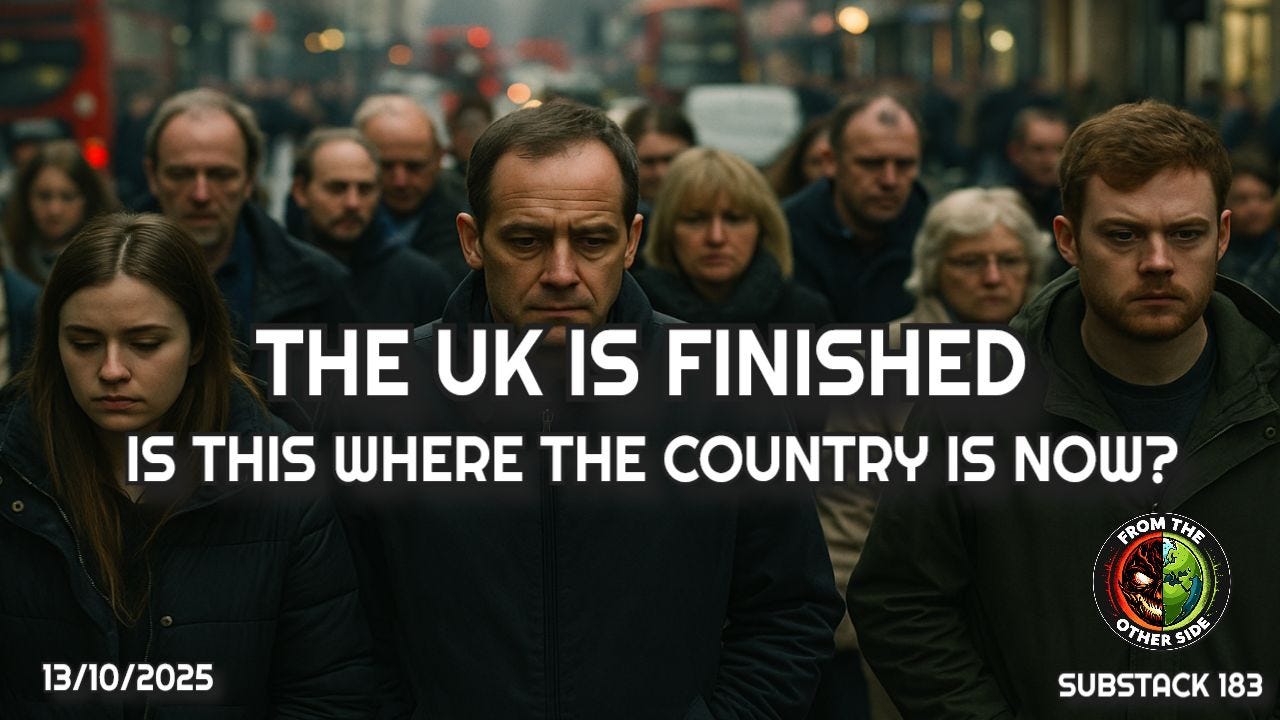
THE UK IS FINISHED: IS THIS WHERE THE COUNTRY IS NOW?
As the United Kingdom grapples with persistent economic pressures and societal shifts, a growing chorus of voices argues that the nation has reached a breaking point. What follows is an unflinching examination of the systemic issues plaguing Britain, drawing from widespread public sentiment and recent data highlighting the depth of the cost-of-living crisis. With inflation, housing affordability, and public service strains at the forefront, many feel the country is teetering on the edge of irreversible decline.
The UK is finished and there is no polite way to put it. What was once called a developed nation has become a playground for corrupt politicians, greedy corporations, and parasitic landlords feeding on people who are simply trying to survive. The working class has been gutted from the inside out. People are working full time, even taking on second jobs, and still cannot cover the basic cost of living. It is not about laziness or poor budgeting. It is that the system itself has been designed to bleed every last drop of effort, money, and dignity from the average person.
Recent surveys reveal that over one in three working Britons have less than one month’s savings, underscoring the precarious financial reality for millions.
Everything that once made this country liveable has been dismantled. A home that cost £700 a month a decade ago now costs £1,500 or more, often for damp, mouldy, low quality flats. Food prices have exploded to the point where a hundred pounds barely fills two carrier bags. Council tax, gas, electricity, fuel, water, and insurance all rise year after year while wages remain frozen. It no longer feels like you are earning money. It feels like you are temporarily renting it before it gets snatched away through endless hidden charges and taxes.
High inflation rates have disproportionately impacted everyday expenses, with 57% of UK households reporting increased costs as of January 2025.
The government taxes income, property, spending, savings, fuel, and even death. You are taxed to live and taxed to die. Nothing is free and nothing is fair. Meanwhile the people who create nothing and contribute nothing keep pocketing bonuses, handouts, and expense claims that could feed entire families for a year. The rich buy influence, politicians sell out, and the rest of us are left fighting over scraps while being told to “tighten our belts.”
Public services are a joke. The NHS is crumbling under deliberate neglect. Schools are underfunded while billions are funnelled into foreign wars and pet projects that do nothing for the people who actually live here. Roads fall apart, hospitals run out of staff, and police spend more time protecting politicians than protecting the public.
Yet the taxpayer is blamed for every failure.
Public discourse on platforms like X echoes these frustrations, with users linking the crisis to broader policy failures, including Brexit’s lingering effects on food prices and economic stability.
Every element of life has been turned into a profit scheme. Owning a home is a fantasy, saving money is impossible, and even eating healthy has become a luxury. People are skipping meals to feed their children. Pensioners are sitting in the cold to avoid heating bills. Families are drowning in rent debt while the media distracts everyone with celebrity gossip and cheap entertainment. The country is rotting while those in charge pretend everything is fine.
And now they are preparing the next stage. The digital ID. They will tell you it is for convenience or security, but anyone paying attention knows what it really is. It is about total control. Once your ID, finances, medical records, and location are connected, you are no longer free. They will know what you buy, where you go, and what you say. Step out of line and access can be restricted instantly. It is the same system being tested globally. A digital leash dressed up as progress.
The UK government’s recent announcement of a mandatory digital ID scheme, set to roll out in 2025 to combat illegal migration and enhance employer checks, has sparked debate. Proponents argue it will streamline processes and close loopholes, while critics view it as a potential tool for surveillance and a £600 million tax grab via HMRC integration. An online petition against the scheme has neared 2,900,000 signatures, reflecting widespread public unease.
Britain is not free. It is a managed plantation where citizens are data points, profits, and statistics to be manipulated. Every policy benefits banks, corporations, and the political elite while punishing anyone who works for an honest living. The illusion of democracy has collapsed. We are governed by career liars who act as middlemen for global interests. They sell national assets to private investors, hand over sovereignty to unelected organisations, and then lecture the public about “doing their part.”
This is not a cost of living crisis. It is a cost of survival crisis. The UK has become an expensive cage. The people know it, the politicians know it, and the corporations thrive on it. The country is finished not because it could not be saved, but because those in power never wanted to save it. They wanted to drain it until nothing was left.
The UK is done. Completely, entirely, and deliberately. While this perspective resonates with many amid ongoing hardships, others point to global factors influencing the crisis, such as international inflation and post-Brexit adjustments.
Optimistic forecasts from institutions like the IMF suggest potential stabilization through reforms, but for now, the debate rages on social media and beyond, with calls for systemic change growing louder.
As Britain navigates these turbulent times, the question remains: Can it reclaim its footing, or is this truly the end of an era?
And so we’re left here, watching a slow collapse wrapped in PR and patriotism. The rich get richer, the poor get blamed, and the middle just disappears.
Conclusion
Britain stands at a crossroads, though the road ahead looks more like a dead end. The political class has no intention of fixing what it broke, and the public has been numbed into quiet acceptance. Yet beneath the surface, anger is building — real anger, not the kind manufactured by headlines. The system is running on borrowed time, and the people it depends on to keep it alive are starting to wake up. When that happens, when enough of them finally refuse to play along, the façade will crack. And maybe then, out of the ruins of this failed experiment, something honest can finally take its place.